

Crop Protection
Terraco offers a full range of crop protection products and custom application equipment, and we will help you with your cropping plans to maximize yield potential. From soil samples to tissue tests and other field scouting, our agronomists can formulate a plan and provide you with recommendations based on sound agronomic practices.
For detailed information about the crop protection products that we distribute, select a manufacturer below.













Fertilizer
Terraco offers a full range of products to promote healthy, high yielding crops. Our experienced team of agronomists can help you review your cropping plans and work with you to maximize your crops’ yield potential. From soil samples to tissue tests, our agronomists can formulate a plan based on sound agronomic practices in order to maximize production and manage costs. Your Terraco team can assist in the recommendation of crop protection products and offer field scouting to ensure the correct product is used.
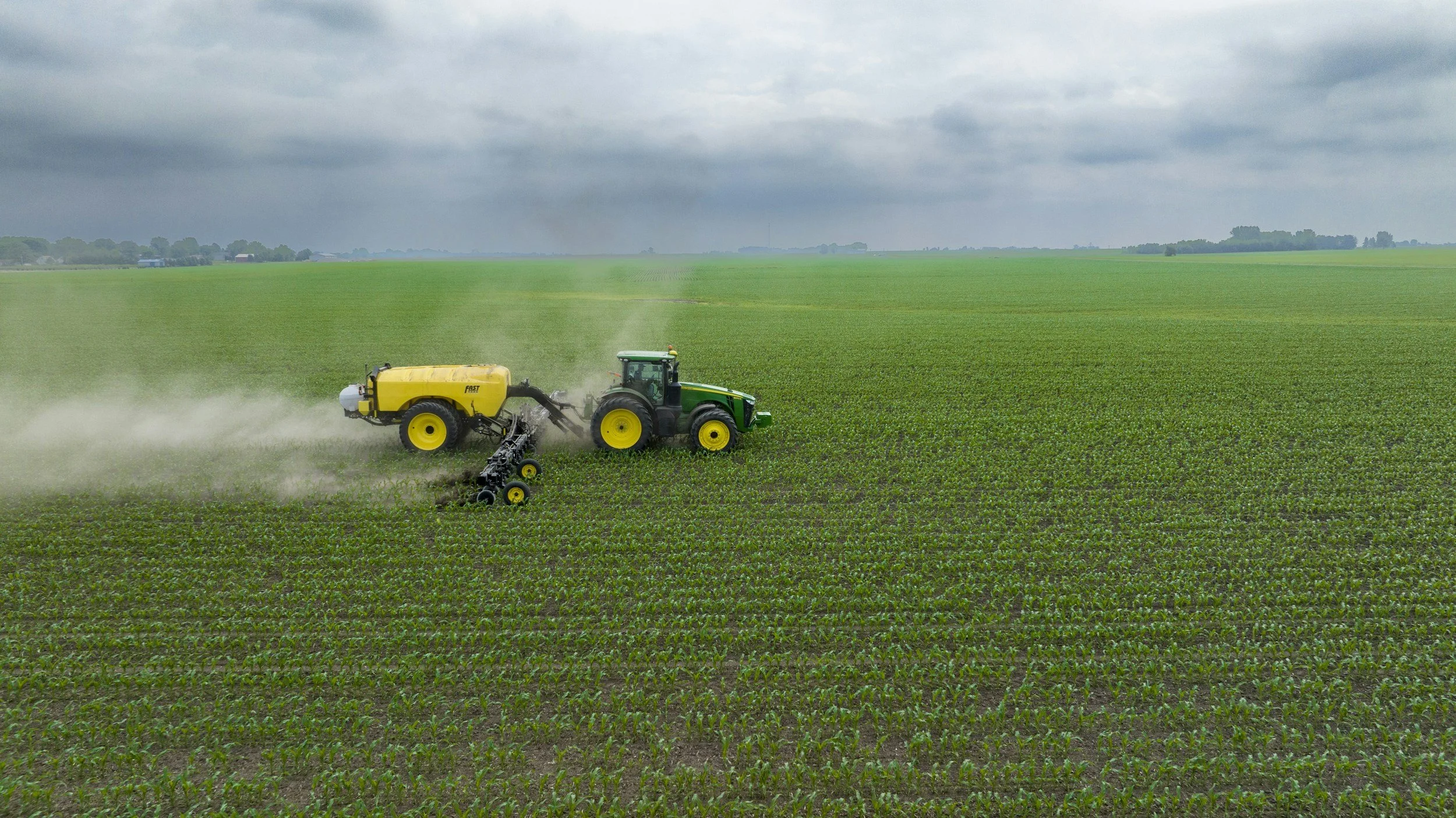
Terraco is equipped with a full line of custom application equipment, like our high clearance sprayers and floaters to apply crop protection products as well as dry and liquid fertilizers. We can also supply you with anhydrous ammonia equipment and delivery.
Whether your fertilizer program includes fall or spring anhydrous ammonia or a complete fertilizer blend, you can be sure our agronomists are experienced in crop production techniques that result in the correct solution for your farm.
Select a product from one of the categories below to access detailed product information.
Nitrogen Fertilizers
-
Foreword:
UAN solution has a nutrient content of 28–0–0–0 (% N–P2O5–K2O–S) in a water solution that is fairly popular in Western Canada as a nitrogen source, especially in Manitoba.
UAN solution can be used in several applications, including fall banding, spring banding or broadcasting prior to seeding, broadcasting in winter annual and perennial systems, foliar “top–dressing”, and as part of a one–pass seeding system.
Popularity is driven by a reduced need for specialized application and storage equipment and excellent blending characteristics for use in one–pass operations.
Properties of Urea-Ammonium Nitrate Solution:
UAN is a mixture of urea, ammonium nitrate, and water.
Half of the nitrogen comes from the urea form and half comes from the ammonium nitrate form.
50% of nitrogen is in the urea form, and 50% is in the nitrate form.
UAN is chemically compatible with many pesticides making “weed and feed” applications to crops possible.
Factors Affecting UAN Retention in the Soil:
Banding losses can be higher than with urea or anhydrous ammonia because the nitrate portion can be prone to leaching.
Less prone to volatilization losses than urea because only 50% of the nitrogen is ammonia.
High risk of volatilization or immobilization (tying up in organic matter) losses occurs when UAN is sprayed on the soil or onto crops. Take similar precautions to those listed under the “Factors Affecting Urea Retention in the Soil” section.
-
Foreword:
Urea has a nutrient content of 46–0–0–0 (% N–P2O5–K2O–S) making it the most concentrated granular form of nitrogen fertilizer available in Western Canada. This is the most popular nitrogenous fertilizer form in Western Canada (2nd most popular in Manitoba).
The popularity of this product is driven by its stability as a molecule and its ability to be blended with other types of fertilizer.
The application of urea as a nitrogen source includes fall banding, spring banding or broadcasting prior to seeding, broadcasting in winter annual and perennial systems, and as part of a one–pass seeding system (especially in no–till conservation systems).
Properties of Urea:
Urea is formed by reacting NH3 and CO2 under high pressure to form a non–ionic, soluble, mobile, organic molecule that is identical to a natural component of animal urine.
The product is available in a solid form that makes it a highly versatile nitrogen form for various applications in agriculture.
Urea can be prone to caking due to a moderate attraction to water; this is compounded by warm temperatures.
Factors Affecting Urea Retention in the Soil:
Banded urea acts much the same way as banded ammonia (see “Factors Affecting Ammonia Retention in the Soil”).
Broadcast urea is prone to volatilization losses (“gassing off of nitrogen into the atmosphere”) if not incorporated into the soil. This can be minimized by:
Holding off application until rain is likely (this will “wash” the nutrient into the soil where losses are reduced).
Avoiding broadcasting during period of high temperatures as this will accelerate losses.
-
Foreword:
SuperU has a nutrient analysis 46–0–0–0 (% N–P2O5–K2O–S) and is available in the granular form.
SuperU is a ready–to–use, premium fertilizer. SuperU is unsurpassed in terms of productivity and efficiency.
Features & Benefits
Using urease and nitrification inhibitors, SuperU protects against all three forms of nitrogen loss – volatilization, leaching and denitrification.
The ability to protect nitrogen is uniformly integrated within every granule by means of N–TEGRATION Technology.
Super U is readily available for plant uptake.
SuperU allows for broader and more even spread patterns. This means growers can cover more acres in less time than with UAN and anhydrous.
SuperU offers reduced handling time and is not sticky or gummy.
SuperU allows for a more flexible application. Growers know their investment is protected even when applied to the surface.
-
Foreword:
Anhydrous ammonia has a nutrient content of 82–0–0–0 (% N–P2O5–K2O–S) making it the most concentrated form of nitrogen fertilizer in Western Canada.
This is the most popular nitrogenous fertilizer form in Manitoba (2nd most popular across Western Canada).
Popularity is driven by its relatively low manufacturing and transportation costs.
Ammonia is typically banded in the soil prior to the planting of solid seeded crops, either during the previous fall or in the spring either before seeding or as part of a one–pass seeding system (especially in no–till conservation systems).
Properties of Anhydrous Ammonia:
Anhydrous ammonia has a strong affinity for water meaning great caution is required when working with the product. Coming in contact with ammonia can cause severe skin burns and damage to lung tissue because of the dehydrating nature of ammonia.
Anhydrous ammonia is a chemical composed of one atom of nitrogen and three atoms of hydrogen; it is produced from nitrogen in the air and hydrogen from natural gas.
Under normal temperatures and pressures, it exists as a gas, but is easily compressed to a liquid.
The boiling point of this compound is �33° C.
As a gas, anhydrous ammonia is colourless, considerably lighter than air and has a pungent, irritating odour.
For agricultural applications, anhydrous ammonia is stored as a liquid under pressure in specially fabricated tanks.
Factors Affecting Retention in the Soil During Application:
Low losses exist in soils near field capacity for moisture.
Excessive moisture may cause sealing problems (leads to direct loss to atmosphere).
Wet or dry lumpy soil will increase losses.
Increasing soil clay and organic matter contents provide increased capacity to absorb NH4+.
An application depth of 10–15 cm (4–6”) is recommended for Manitoba soils; the deeper end of the scale should be targeted for sandier soils.
Wider applicator spacing leads to high application rates per shank that may exceed subsurface soil capacity for the nutrient.
-
Wheat:
2.0 to 2.5 lbs N per bushel is needed for wheat production.
About 80 % of N uptake is completed before the heading phase of crop growth.
N is a vital component of proteins and chlorophyll in the plant.
The N in the chlorophyll is required for photosynthesis.
Adequate supplies of nitrogen to the plant can improve water use efficiency (important in more arid regions).
Both nitrate (NO3–) and ammonium (NH4+) forms are readily taken up by the wheat plant.
Grain protein levels less than 14% indicate insufficient N and yield loss is a likely result.
Low grain protein level also results in poor bread quality.
Soil testing prior to seeding will help establish required levels of nitrogen required to maximize returns on nitrogen applications.
Canola:
A 35 bushel per acre crop of canola takes up approximately 100 lbs of N per acre.
N is a vital component of proteins and chlorophyll in the plant which are necessary for photosynthesis.
Leaf area of the plant is increased with higher available nitrogen.
N promotes the development of more flowers per plant; that translates into more pods.
Maximum nitrogen uptake occurs during the flowering stage of canola growth.
Rates of N fertilizer in excess of realistic yield goals can cause lodging and reduce both harvestability and yield of the canola crop.
Because of the large N requirement at flowing of canola, early deficiency symptoms can be corrected by top–dress applications.
Soil testing prior to seeding will help establish required levels of nitrogen required to maximize returns on nitrogen applications.
-
Foreword:
ESN has a nutrient analysis 44–0–0–0 (% N–P2O5–K2O–S) and is available in the granular form.
ESN is a controlled release nitrogen fertilizer. ESN is a urea granule contained within a flexible polymer coating.
The flexible polymer coating protects the nitrogen from loss mechanisms and releases nitrogen in response to soil temperature.
ESN give crops all the nitrogen they need when they need it.
How ESN Works
ESN’s polymer membrane allows moisture to diffuse into the granule creating a nitrogen solution.
The solution moves out through the membrane at the rate that is controlled by soil temperatures and in doing so, matches the nitrogen demand of the growing crop.
Nitrogen release is primarily driven by soil temperature.
Features & Benefits
Nitrogen will remain encapsulated and releases N over a period of 50–80 days protecting the nitrogen during the periods of, generally, greatest losses.
In most soils, the polymer coating will decompose in 18–24 months The end–product of the decomposition are carbon diocide, ammonia, and water.
ESN can be placed in the seed row or applied via banding or broadcasting through the use of spin spreaders or air flow machines.
ESN allows for greater seed row safety over urea or AMS nitrogen sources.
Within the Canadian Prairie provinces – safe rate guidelines exist for nitrogen placed with the seed, on the provincial agricultural websites.
ESN can be used at 3X indicated rates when it is 100% of the N source, ESN can be used at 2X the existing safe rate when it is 70% of the N source and at 1.5X the safe rate indicated, when it is 50% of the total N source.
Phosphorus Fertilizers
-
Properties of MAP:
Ammonium Polyphosphate has a nutrient content of 10–34–0–0 (% N–P2O5–K2O–S) is the form of a liquid solution.
Contains nitrogen which is readily available for uptake early in the growing season.
APP is manufactured in two stages:
Phosphoric acid is condensed, using heat, to form polyphosphate.
Ammonia is reacted with polyphosphate.
The final product contains P compounds in various stage of condensation.
APP is an expensive product to manufacture because high quality phosphoric acid is required.
This product blends easily with other liquid fertilizers.
Use of APP:
Use of this product is similar to that of MAP, however, it is used in liquid application systems.
-
Properties of MAP:
Monoammonium Phosphate has a nutrient content of 11–52–0–0 (% N–P2O5–K2O–S) and is available in a granular form.
This is the most popular phosphate fertilizer in Western Canada.
This product is formed by the addition of ammonia to phosphoric acid.
MAP is relatively inexpensive to manufacture and easy to handle.
MAP also contains nitrogen that is available to plants early in the growing season.
MAP is water–soluble and is readily available as soon as it comes in contact with soil moisture.
Use of APP:
This product is generally placed with or very near the seed row as phosphorus is an immobile nutrient.
Phosphorus is needed close to the developing seedling in the spring to initiate root growth under the cooler soil conditions. This will get the plants off to a quicker start.
MAP can also be broadcast on perennial forages that are beginning to age. High rates are required for this method as the nutrient is immobile and much of it will remain at or near the surface.
-
Wheat:
Wheat requires approximately 0.6 to 0.7 lbs P2O5 per bushel of grain.
As much as 70% of P uptake occurs before the heading stage of wheat growth.
P is essential for vigorous root and shoot growth.
P will also increase tillering and grain heads per acre in a wheat crop.
Large yield increases are seen when applying fertilizer P on deficient soils.
This nutrient is necessary for energy storage and transfer in plant systems.
Because it is immobile in soil, P needs to be placed where it can easily be accessed by plant roots.
P can help overcome the effects of soil compaction.
Adequate supplies of P increase water use efficiency of a wheat crop.
P advances the maturity of a crop and helps lower grain moisture levels at harvest.
P will improve the efficiencies of other inputs, especially N.
Soil testing prior to seeding will help establish required levels of phosphorus required to maximize returns on P applications.
Canola:
P is essential for a strong, healthy root system, especially during the early growth stages of canola in cold soils.
This nutrient promotes early growth, uniform flowering and pod development; this can help timing for pest control products such as fungicides.
P is needed for energy storage and transfer.
Phosphorus improves water use efficiency of the canola crop.
A 35 bushel per acre crop takes up about 50 lbs of P2O5 per acre.
The response to P fertilization is limited if N supply in the soil is low.
Starter P is beneficial even under high soil test levels.
Severe deficiencies cause poorly developed roots, thin, erect stems with little branching, and narrow, bluish–green leaves.
Soil testing prior to seeding will help establish required levels of phosphorus required to maximize returns on P applications.
-
Foreword:
Croplex has a nutrient content of 12–40–0–10 + 1 Zn+ 1/3 B (% N–P2O5–K2O–S + lbs Zn + lbs B) and is available in the granular form.
8–9lbs higher crush strength than competitor NPS homogeneous products.
5 lbs. sulfate S and 5 lbs liquid elemental S. Liquid is smaller particle size and more easily weathered and broken down into a plant useable form.
1lb. of Zinc sulfate. This is the industry standard form of Zinc in most NPS homogeneous phosphate products today.
1/3 lb. of Boron Tri–oxide. This form is more slowly mineralized vs Sodium borate and more sustainable for late season boron supply.
Lower heavy metals and impurities in our phophate Rock supply. Mainly extremely low Cadmium levels vs the other homogeneous P products from North American manufacturers.
Bulk density is 56 lbs/cu. ft.
Has a pH of 4–5.
Salt index testing is coming back virtually equal to NPS products in lab testing for seed safety.
Nutrient breakdown in Croplex:
Nitrogen
Ammonium (NH4+) included in Croplex.
This has a slower transaction with water in soil and is readily available by desorption.
This is a sustained N supply and has no risk of leaching losses.
NH4+ favors the local acidification of the shizosphere, which often enefits phophorus uptate.
Phosphorous
Lower heavy metal content, which gives a lighter color.
Higher phosphate solubility (45–48% solubility in the year of application).
Sulphur
Croplex provides sulfur in both sulfate and liquid elemental forms (50–50 ratio) to satisfy immediate nutrient uptake requirements while also ensuring longer–term availability.
A positive correlation exists between the surface area and the oxidation speed of elemental S into sulfate S.
The more particle per unit of elemental S, the bigger the total surface area, which means that the micronized sulfur particles provided in Croplex increase the total surface area in contact with soil and therefore speed up the reaction time.
Zinc
Zinc sulfate is the plant available form of zinc which is in Croplex.
Boron
Boron trioxide breaks down more slowly and is available thru 3/4 of the growing season during flowering and peak Boron demand in our crops.
Sodium borate will dissipate more quickly and not be plant available during the flowering stage.
Sulphur Fertilizers
-
Overview:
Elemental sulphur has a nutrient content of 0–0–0–90 (% N–P2O5–K2O–S).
This product requires a process of microbial oxidation before it can become plant available.
Elemental S causes a reduction in pH, a process that solubilizes phosphate. Using elemental S in phosphate blends can greatly increase phosphate uptake by plants for this reason.
Elemental S fertilization is often done on a long–term building program due its slow–release properties. This can be useful in perennial crop production to allow the slow release of sulphur over time.
-
Overview:
Ammonium Thiosulphate has a nutrient content of 15–0–0–20 (% N–P2O5–K2O–S) and is the most popular form of liquid sulphur fertilizer.
This product is compatible with nitrogen and phosphorus solution fertilizers.
The effectiveness and use of ATS is similar to AS (21–0–0–24).
-
Overview:
Ammonium Sulphate has a nutrient content of 21–0–0–24 (% N–P2O5–K2O–S) and is a popular granular form of sulphate and nitrogen fertilizer in Western Canada.
Product is available in granules that are similar in size to other ‘dry’ forms of fertilizer to allow for the blending of product.
Nitrogen available in AS is in the ammonium form.
The nitrogen component of this product is discussed in the “Nitrogen Fertilizers” section.
Sulphur in AS is in a highly plant available sulphate (SO4–) form shortly after application to soil, however, this is slowly tied up by calcium and phosphate in our soils over time.
This product is used either as a broadcast application or as band, often in a blend with other fertilizer types, done at the time of seeding.
-
Wheat:
A high yielding wheat crop requires about 0.25 lbs of S per bushel of wheat.
S in wheat is a part of several amino acids and proteins.
S can increase N and P use efficiency.
This nutrient is essential for chlorophyll formation.
Plants take up only the sulphate form.
S rates can affect flour quality and loaf volume.
Soil testing prior to seeding will help establish required levels of sulphur required to maximize returns on S applications.
Canola:
Sulphur is critical for canola production; deficiency frequently lowers canola yields.
A 35 bushel per acre canola crop takes up about 20 lbs of S per acre.
S is a constituent of certain amino acids needed for protein synthesis in canola.
S improves the quality of canola seed including oil content.
Deficiency will greatly reduce N uptake.
Application of S needs to be balanced with N for optimum yields. Typical N:S ratios range from 7:1 to 5:1.
Soil testing prior to seeding will help establish required levels of sulphur required to maximize returns on S applications.
Potash Fertilizers
-
Overview:
Potash has a nutrient content of 0–0–60–0 (% N–P2O5–K2O–S) and is the most commonly used K2O fertilizer used in North America.
Potash is a mined product coming from deposits left by evaporated inland seas (mainly in Saskatchewan).
Product is sold in a crystal granular form in similar proportion to other granular fertilizers to allow for blending.
Potash can be banded or broadcast, however, most applications include a band at seeding.
Potassium (K2O) in Wheat Production:
Wheat requirements for K are approximately equal to N requirements.
About 85% of K uptake occurs before the heading stage of the crop.
More than 3 lbs per acre of K2O are taken up each day during the period of peak demand.
Higher N availability increases K requirements.
K is essential for many enzyme systems.
K helps plants tolerate moisture stress, lowers incidence of disease, and helps reduce lodging of the crop.
K can greatly increase water use efficiency.
This nutrient affects the speed of chemical reactions in the plant.
K increases stem diameter and strength (relates to reduction in lodging).
Increased grain weight and reduced shriveled grains have been identified with K fertilization.
In colder, drier climates, K responses may also occur on high K soils.
Soil testing prior to seeding will help establish required levels of potassium required to maximize returns on K applications.
Potassium (K2O) in Canola Production:
A 35 bushel canola crop takes up about 85 lbs of K2O.
K is involved with enzyme activation, photosynthesis and sugar translocation.
This nutrient improves the crop’s frost and drought resistance.
K helps build disease and insect tolerance by promoting the healing of wounds from insects, hail or wind.
K also helps prevent lodging in canola.
Soil testing prior to seeding will help establish required levels of potassium required to maximize returns on K applications.